Best Freestanding Display Units for Seasonal Merchandise
Freestanding display units (FSDUs) give Australian retailers a flexible way to promote seasonal products, special offers and new ranges. Because they stand on their own, retailers can position them where they need extra merchandising space.
The best FSDU depends on your products, available floor space and how often your displays change. Modular systems can add flexibility because shelves, hanging rails and other accessories can be changed as your merchandise changes.
Which freestanding display unit works best?
Choose a Freestanding Display Unit (FSDU) that suits the size, weight and quantity of the products you need to display. Don’t simply choose the tallest or cheapest fixture.
As a general merchandising guide, smaller freestanding displays can work well for accessories, packaged goods and impulse lines. Shelving and hanging displays suit apparel, footwear and larger products.
For larger ranges, Apex Display’s UniSlot Modular Gondola is a freestanding system designed for centre-of-store merchandising. It can be configured with shelving, hanging rails or a mix of both. Multiple gondolas can also be joined to create longer runs.
Think about capacity, flexibility and available floor space. A larger fixture gives you more merchandising room, while a compact unit may be easier to work into an existing store layout.
Where should you place freestanding displays?
There is no single position that will perform best in every store. Customer traffic, store layout and the type of merchandise all affect the result.
As a general merchandising approach, test FSDUs in visible areas such as entrances, gondola ends and busy paths through the store. Then compare how each location performs.
Don’t place a display in an empty corner simply because the space is available. Consider how customers move through your store and whether they can see the display from their normal shopping path.
Keep promotional signage short and easy to understand. Before each campaign, mark possible FSDU locations on a floor plan and match the fixture to the products you plan to display.
Why choose a modular display system?
Some promotional displays are built for a single campaign. A modular system takes a different approach by allowing retailers to change the fixture configuration as their requirements change.
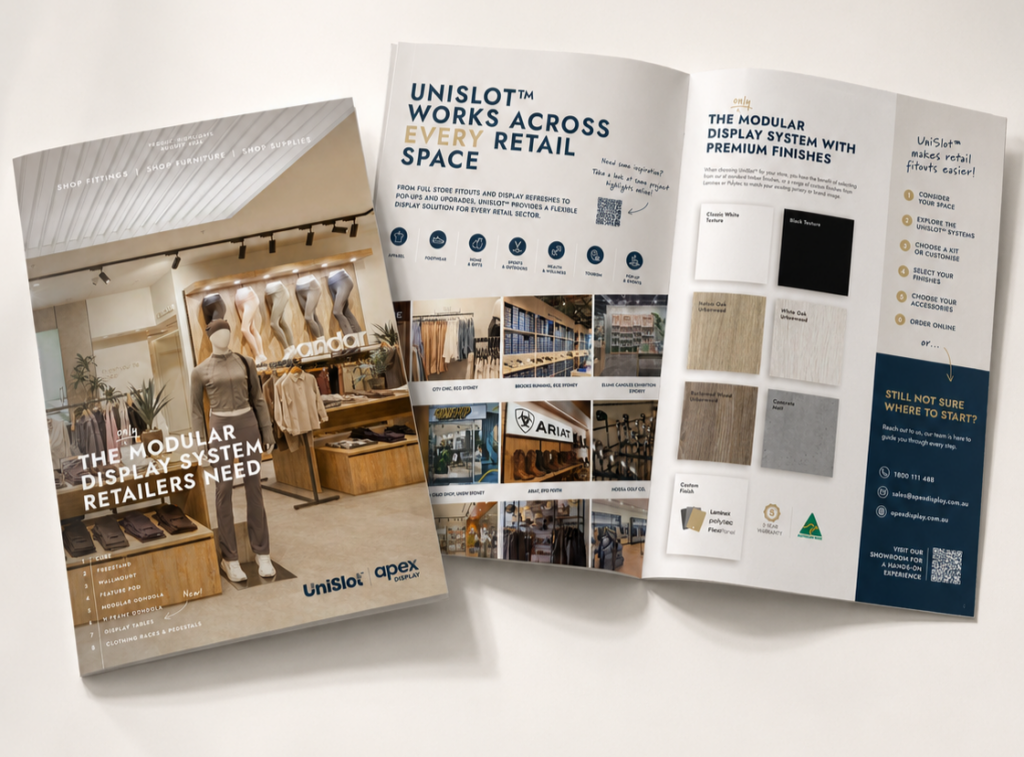
Apex Display’s UniSlot shopfitting system supports interchangeable shelving, hanging rails, hooks and other merchandising accessories.
Apex’s own retail projects show how this works in practice.
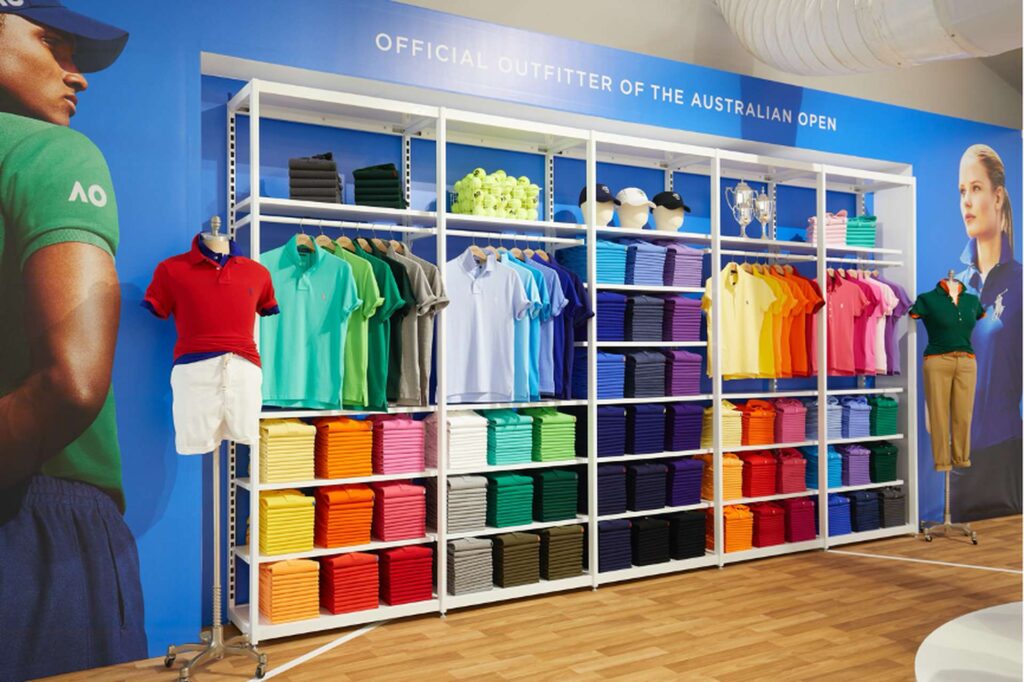
Ralph Lauren: the same fixtures across three Australian Opens
Apex Display supplied UniSlot Cube fixtures for Ralph Lauren’s Australian Open retail pop-ups in 2021, 2022 and 2023.
According to Apex Display’s 2023 catalogue, Ralph Lauren used the same metal fixtures each year while updating the timber accessories to suit the brand direction.
This is a clear example of a retailer reusing the main display hardware while changing other elements for a new campaign.
LSKD: a temporary retail space built for an event
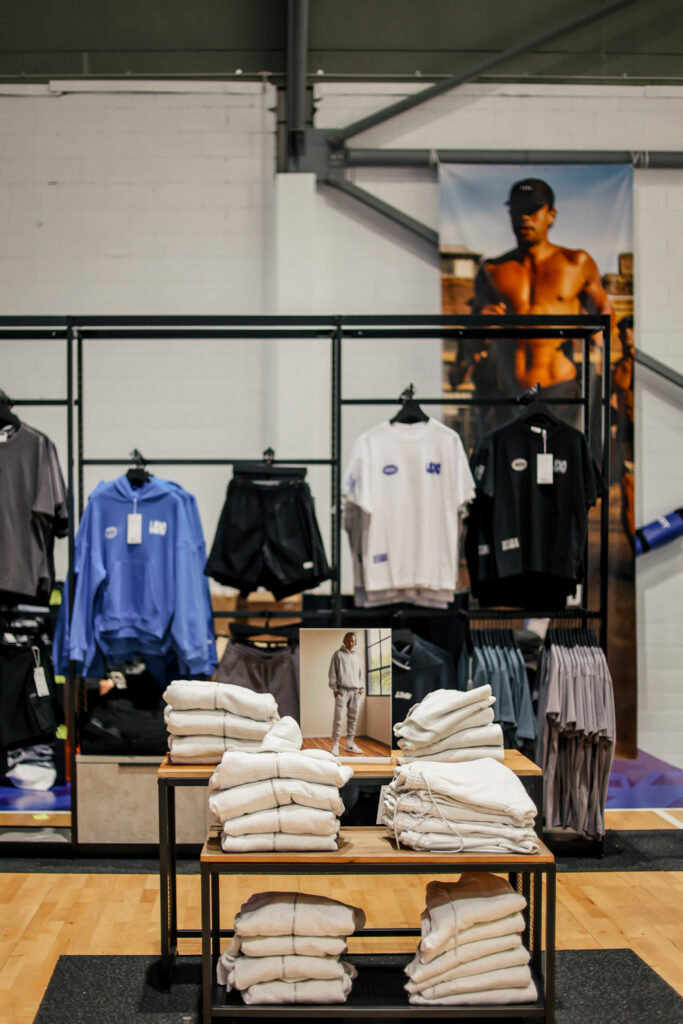
For the LSKD 1% Better Hub at HYROX Brisbane, Apex Display supplied UniSlot Cube, Modular Gondolas and H-Frame Gondolas.
The event space needed to support retail and other activities without permanent changes to the venue. Apex reports that the system was installed in less than a day, required no permanent fixings and could be removed after the event.
This project shows how freestanding modular fixtures can suit pop-ups, events and temporary retail environments.
See more modular pop-up and activation solutions.
Can modular displays work beyond seasonal campaigns?
Yes. Apex Display’s project portfolio includes permanent stores, pop-ups, activations, exhibitions and other retail environments.
Queensland Museum Kurilpa in Brisbane is one example. Its retail store uses UniSlot Wallmount and Freestand systems to support a space that changes as exhibitions change.
The project uses adjustable shelving and changeable graphic panels so the store can update its product presentation and visual theme without replacing the main display system.
View the Queensland Museum Kurilpa project.
For retailers, the broader lesson is to consider more than the next seasonal campaign. Think about whether the same fixture could support product launches, promotions, clearance stock and everyday merchandising.
How should you plan a display changeover?
The following is general operational guidance rather than a rule for every store.
Where possible, avoid rebuilding a large display during your busiest trading period. Prepare your products, fixture parts and signage before you remove the existing display.
A simple checklist can cover the fixture components, stock, shelf or hook positions, signage and final safety checks.
Complete the changeover during a quieter period where practical. Always follow the fixture manufacturer’s assembly instructions and load ratings, especially when displaying heavy products.
What is the difference between an FSDU and standard retail shelving?
An FSDU stands independently on the shop floor. It doesn’t need to attach to a wall or form part of a permanent shelving run.
This can make freestanding displays useful when retailers need to change layouts, create temporary merchandising areas or reposition displays.
Wall-mounted shelving can be a better option when you want to use perimeter space and keep more of the shop floor open.
How many FSDUs does a small store need?
There is no evidence-based number that suits every small retail store.
As a practical starting point, focus on a small number of well-planned displays rather than filling every available space. Then review customer flow, sales performance and congestion before adding more.
The right number will depend on your floor area, product range, stock levels and existing fixtures.
How early should you order an FSDU?
Lead times vary by supplier, product, stock availability, freight and customisation, so avoid relying on a fixed four, six or eight-week rule.
Ask your supplier to confirm the current lead time before setting your installation date. Allow additional time if your project needs custom finishes, branding or made-to-order components.
Apex Display also lists a range of UniSlot kits for retailers looking for preconfigured options.
Make your next display work beyond one campaign
The right FSDU doesn’t have to serve only one seasonal promotion. Apex projects such as Ralph Lauren’s Australian Open pop-ups and LSKD’s HYROX Brisbane activation show how modular fixtures can support changing campaigns and temporary retail environments.
A flexible system can also support product launches, promotions and everyday merchandising as your needs change.
Explore the Apex Display project portfolio to see how UniSlot systems have been used by Australian and international retailers.
Planning a new retail display?
Send Apex Display your product dimensions, expected stock volume, available floor space and campaign timing. Request a recommended UniSlot configuration and quote to see how one modular system could support multiple campaigns without starting from scratch each time.